How do we assess problematic cosmetic ingredients? Our sources explained
Why does The Food App highlight certain ingredients in cosmetics and personal care products as problematic? We explain our sources and what the labels mean for UK shoppers.

Tormund Gerhardsen
Founder of The Food App
A shampoo, moisturiser or deodorant can have an ingredients list that is difficult to make sense of. The Food App helps you spot ingredients associated with allergies, suspected endocrine-disrupting properties or environmental concerns.
But where does that information come from? Here is a simple guide to our main sources and how we use them.
The Norwegian Consumer Council: Guidance for a precautionary approach
Forbrukerrådet, the Norwegian Consumer Council, maintains an overview of unwanted substances in cosmetics and personal care products. It includes ingredients linked to allergies, suspected endocrine disruption and environmental concerns.
We use this as an important starting point for the ingredients we highlight. Although the organisation is Norwegian, its guidance draws on European chemical assessments that are relevant to ingredients found in UK products too.
Advice to avoid an ingredient is not the same as a legal ban. The Council takes a precautionary approach and considers combined exposure from different sources.
ED Lists: Understanding endocrine-disrupting properties
ED Lists is a collaboration between authorities in several European countries. It brings together substances identified as endocrine disruptors and those being investigated for these properties.
The three lists mean different things:
- List I: Substances identified as endocrine disruptors at EU level.
- List II: Substances being assessed for endocrine disruption under EU legislation.
- List III: Substances considered to have endocrine-disrupting properties by a participating national authority.
We use the lists and the assessments behind them to understand the concern. Being investigated does not mean an ingredient has been confirmed as an endocrine disruptor. Assessments may concern human health, the environment or both. That distinction matters.
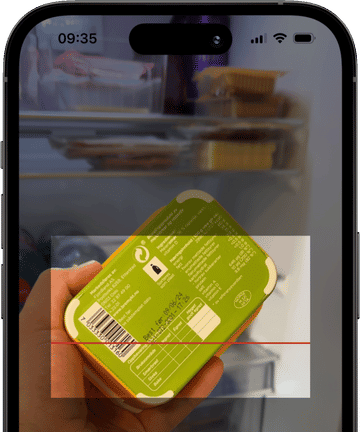
Does your skincare contain problematic ingredients?
Download The Food App to scan or search for cosmetics and personal care products. Scanning is completely free.


Cosmetics rules: Allergens and labelling
Cosmetics rules set requirements for ingredients and labelling. We use EU rules as a source for fragrance ingredients that can cause contact allergy.
Linalool and Geraniol are two examples. They have long been subject to individual labelling above specified concentrations. The EU expanded its fragrance-allergen labelling requirements in 2023, helping people with allergies identify more ingredients they may need to avoid.
EU rules and UK rules are not automatically identical. Great Britain has its own version of the cosmetics framework, while Northern Ireland follows the relevant EU rules. An EU labelling requirement or ban should therefore not be read as automatically applying throughout the UK. The UK government's guidance explains the distinction.
Fragrance-allergen lists are not a complete list of everything that can cause an allergy. Other ingredients, including some preservatives and hair dyes, are assessed and regulated separately.
ECHA: Chemicals, environmental concerns and EU bans
The European Chemicals Agency, ECHA, brings together information about chemical properties and regulation. We use it to investigate environmental concerns and check substances prohibited in EU cosmetics.
ECHA publishes an overview of the EU cosmetics prohibited-substances list. The legal basis is the legislation itself, including any conditions or limits on its scope. Our “Banned in the EU/EEA” label refers specifically to that jurisdiction, rather than stating that a product is illegal in Great Britain.
An environmental concern may mean that an ingredient breaks down very slowly or accumulates in nature. That is a different issue from harm to someone using it on their skin. Newly adopted restrictions may also have a transition period before they apply fully.
SCCS and UK scientific advice
We supplement the main sources with assessments from SCCS, the EU's Scientific Committee on Consumer Safety, and relevant European national authorities.
These assessments can explain which concentrations and uses are considered safe. An ingredient can have properties that warrant attention while a particular use is considered safe within specified limits.
For the UK context, we also refer to official UK guidance. The UK's Scientific Advisory Group on Chemical Safety in Consumer Products, SAG-CS, advises on chemical safety, including cosmetic ingredients. Scientific advice and a legal restriction are different stages of the process.
Does your skincare contain problematic ingredients?
Download The Food App to scan or search for cosmetics and personal care products. Scanning is completely free.
What does this mean when you scan a UK product?
The Food App's labels help you spot ingredients you may want to pay attention to. They are not a complete risk assessment of the finished product.
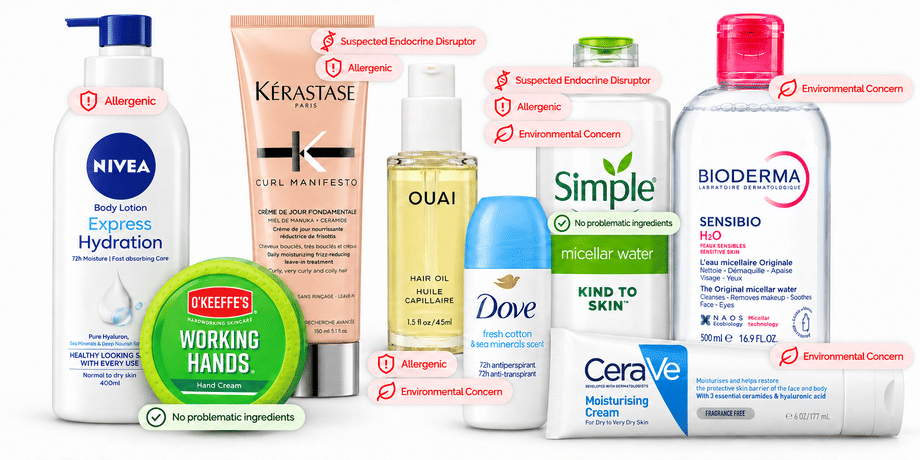
For example, our UK records flag fragrance allergens in Nivea Express Hydration Body Lotion. Bioderma Sensibio H2O is flagged for an environmental concern linked to Disodium EDTA. O'Keeffe's Working Hands has no matched problematic ingredients in our current database. These are different findings, rather than a single overall safety ranking.
Concentration, how you use the product and any existing allergy all matter. The ingredients list alone cannot tell us everything, and a product with no flags is not a guarantee that everyone will tolerate it. Recipes change, so check the current packaging when an ingredient matters to you.
Want to understand why an ingredient is highlighted? Read its description and sources in the app. Our aim is to explain the background so you can make your own informed choices.
Sources and further reading
- Norwegian Consumer Council: Guidance on unwanted chemicals (in Norwegian)
- ED Lists: The three endocrine-disruptor lists
- EU Cosmetics Regulation (1223/2009), as amended
- EU Regulation 2023/1545 on fragrance-allergen labelling
- ECHA: Substances prohibited in EU cosmetics
- SCCS: Scientific opinions on ingredients
- UK government: Cosmetics guidance for Great Britain and Northern Ireland
- UK SAG-CS: Scientific advice on chemical safety