The Food App vs Yuka vs Ivy
Do we really need several food scanner apps? They all serve different needs.

Tormund Gerhardsen
Founder of The Food App
People have different goals and views on a healthy diet. An all composing food scanner app would be overcrowded and tailored to none. These are the pros and cons with different food apps.
What makes The Food App different from other apps
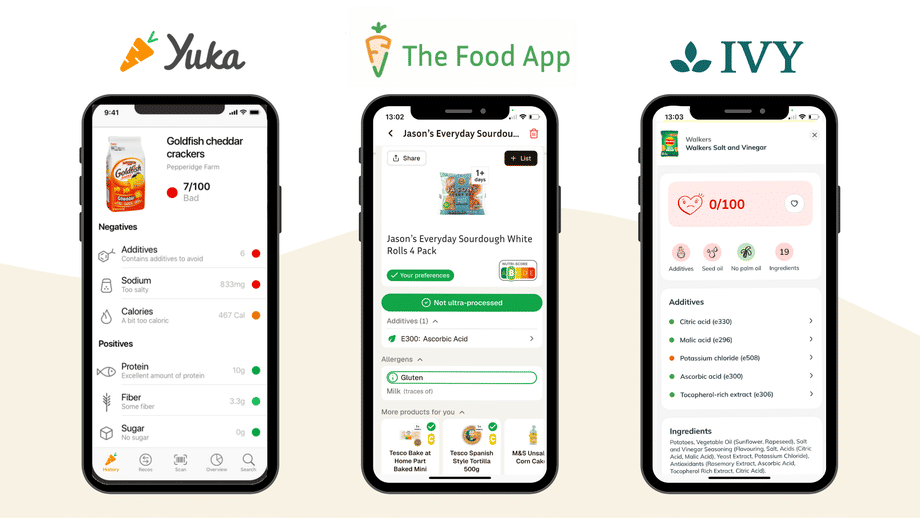
The Food App lets users select standards such as NOVA or Nutri-Score and set their own preferences on additives and ingredients. In comparison, Yuka Food and Cosmetic Scanner and Ivy Processed Food Scanner have created their own health score.
The Food App wants to avoid being the arbitrator of truth, but help users understand what's in the groceries and decide for themselves. Other apps' own systems are easy to understand, but it's not always clear what they are based on. It could be argued that apps don't have competence to give score cards for foods, even though their knowlegable and partly base their judgement on standards such as NOVA.
The app, Open Food Facts, mainly lets users select standards like NOVA, but the open-source project relies on a large volume of user-contributed data that can be inconsistent, incomplete, and difficult to navigate.
Can apps tell if groceries are ultra processed based on ingredients?
Apps can be accurate at identifying ultra-processed foods, however some errors can occur regardless of which app you use. This is because information sources about food products can be wrong or insufficient. Furthermore, what matters is not just which additives are present, but why they are used.
Some additives inherently imply heavy industrial processing. Others only indicate ultra-processing when they replace whole ingredients, extend shelf life beyond for convenience, or intensify flavour and texture. This is a subjective interpretation each app has to make based on general guidelines.
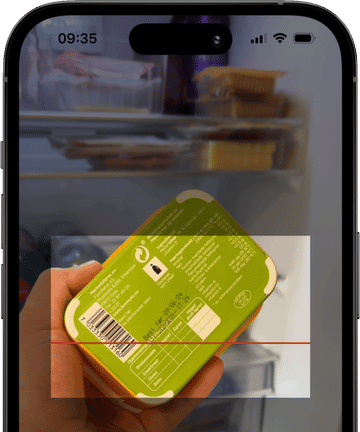
Find out if the food is ultra-processed, for free
In The Food App you can scan and search among thousands of UK products 🇬🇧


Weaknesses and strengths with NOVA and Nutri-Score
The concept of ultra-processed food was introduced in 2010 by researchers at the University of São Paulo in Brazil. They linked higher levels of food processing to obesity and lifestyle-related diseases. This led to the NOVA classification, which groups foods into four categories based on processing level. Ultra-processed foods represent the highest level.
It would be convenient for The Food App to classify different levels of ultra processing as some apps do, but it's not straightforward. Most of the time it's unknown how much of the additives are used and it is difficult to compare their impact. The strength of the NOVA system is also its weakness, it is broadly defined.
The Food App has Nutri-Score as an option because it's seen as the most efficient nutritional grading system in comparison studies. Furthermore, it's recommended by the WHO and has been considered implemented in all of the EU. Studies suggest that it is complementary to ultra processing. Some of the other apps blend nutritional value with processing level in their own single overall rating of foods.
Health misinformation is rampant
Studies on health and social media show that misinformation often is close to 50 percent of commonly viewed content. Even brands and influencers often have incorrect information. The value of food scanner apps lies in curation — filtering, contextualising, and prioritising information so it becomes meaningful and trustworthy. However, when apps introduce their own points of view, this can add to confusion rather than reduce it.
Find out if the food is ultra-processed, for free
In The Food App you can scan and search among thousands of UK products 🇬🇧
Comparing The Food App to Yuka, Ivy and Open Food Facts
Different food apps present information in different ways. They have different target audiences. The Food App uses established standards, instead of having their own rating number or grade. It's a trade-off between convenience and accuracy. The Food App aims to simplify without oversimplification.