
Report: UK Ultra-Processed Food Index 2026

Tormund Gerhardsen
Founder of The Food App
Abstract and key findings
Over 60% of UK foods are ultra-processed, with flavourings as the most common indicator. This is based on our 2026 analysis of 50,000 UK food products, assessing the share classified as ultra-processed (UPFs).
60% of British foods are ultra-processed
By analysing ingredient lists against the NOVA classification, we have found that just over 60% of the food products you find in British supermarkets can be classified as ultra-processed foods (UPFs).
NOVA divides foods into four groups:
- Unprocessed and minimally processed foods
- Processed culinary ingredients
- Processed foods
- Ultra-processed foods
It is NOVA Group 4, ultra-processed foods, that we have examined.
Method
To be classified as ultra-processed, the ingredient list must contain at least one indicator of ultra-processed food as defined by NOVA. These are ingredients that you do not, or only rarely, find in a typical kitchen. For example, additives such as flavourings, colourings, emulsifiers, sweeteners, and thickeners.
Read more: What ultra-processed food is really about
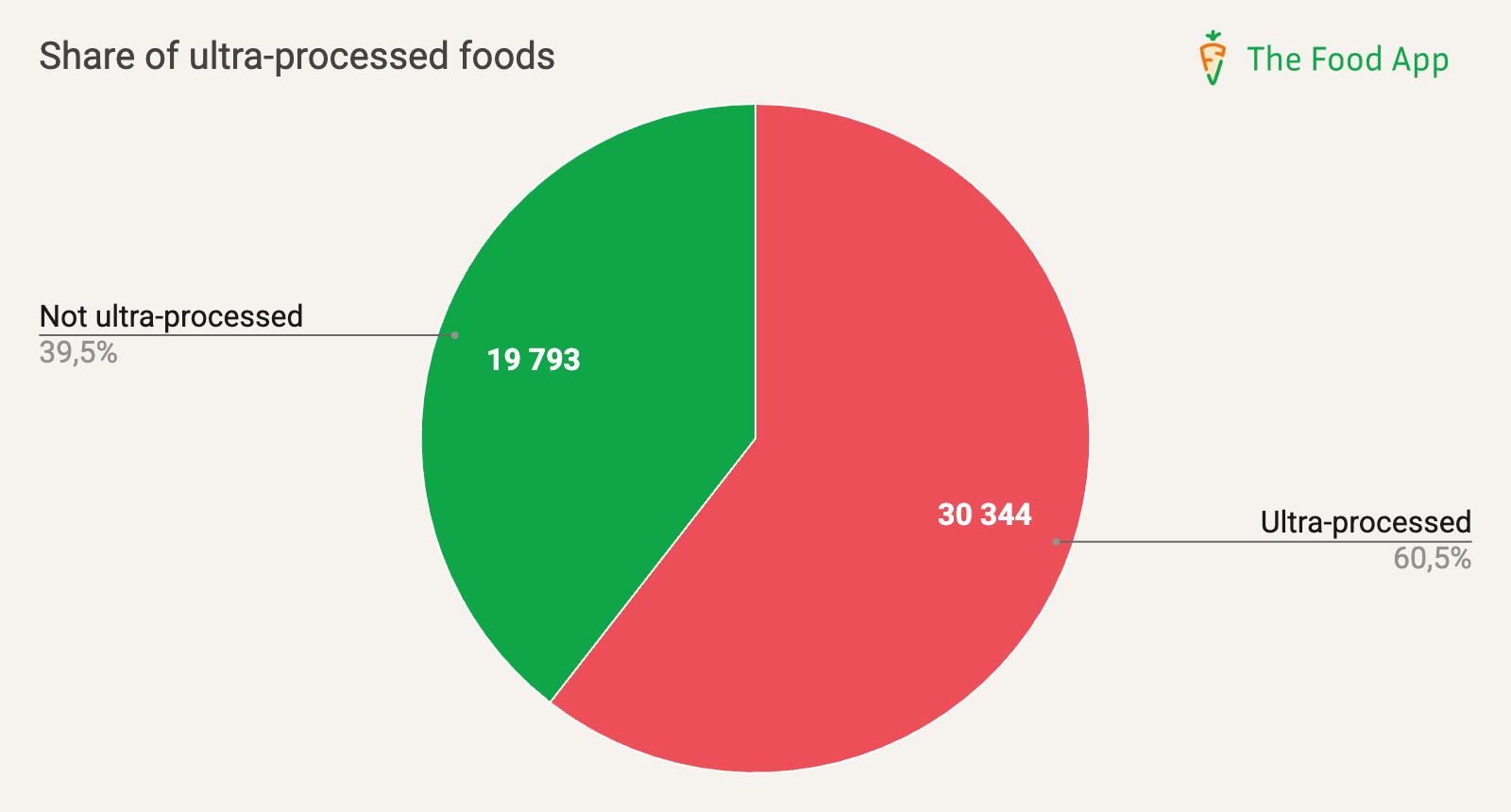
MOST ULTRA-PROCESSED: Of a total of 50,137 food products analysed, 30,344 (60,5%) were ultra-processed and 19,793 (39,5%) were not ultra-processed.
Flavourings are the most common indicator
The indicator that makes the greatest number of foods ultra-processed is flavourings. These appear on ingredient lists either as «flavouring» or «natural flavouring» in as many as 70% of all ultra-processed products.
The issue with flavourings is not necessarily the substances themselves, which are considered safe and are only used in small quantities. Rather, they replace whole ingredients. In other words, they allow manufacturers to use fewer whole ingredients and more fillers.
An example is the difference between these two ketchups. One is ultra-processed, while the other is made from whole ingredients (i.e. not ultra-processed).
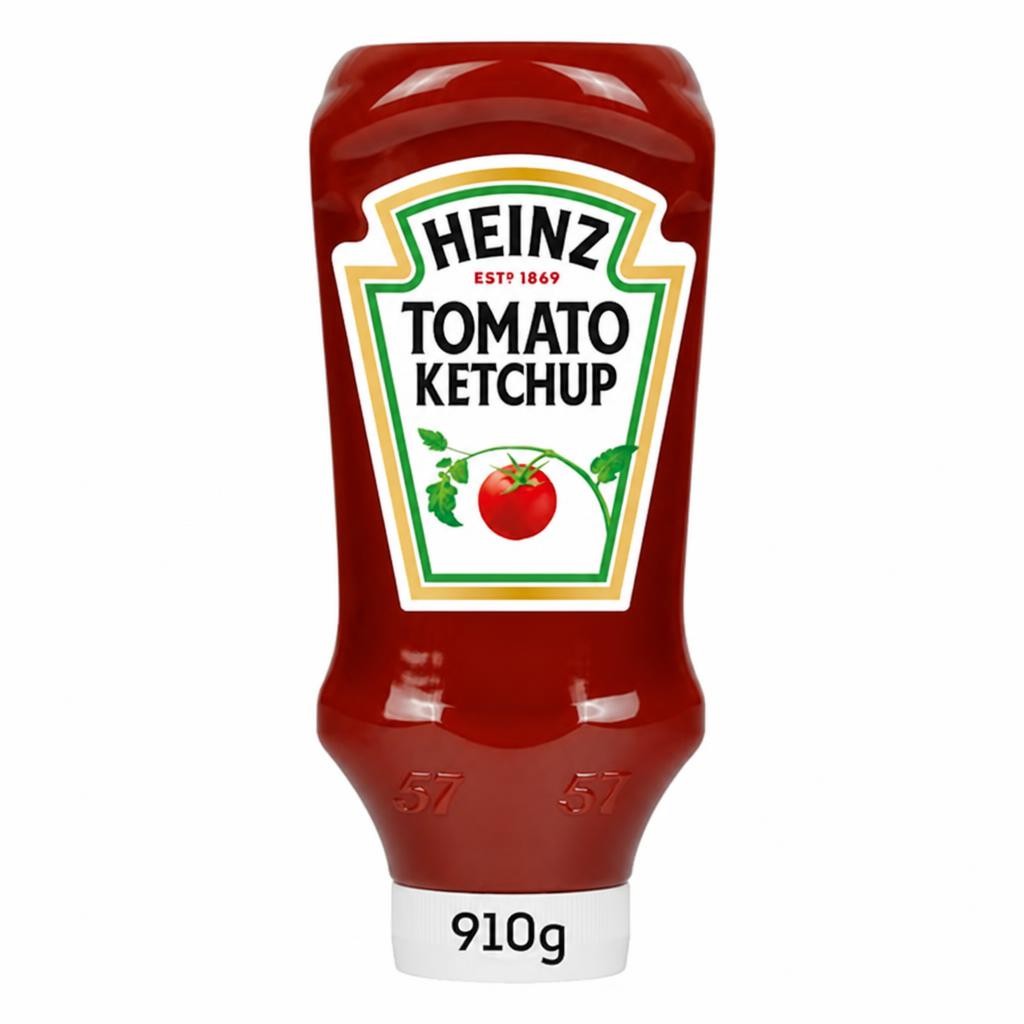
Heinz Top Down Squeezy Tomato Ketchup Sauce 910g
Ingredients: Tomatoes (148g per 100g Tomato Ketchup), Spirit Vinegar, Sugar, Salt, Spice and Herb Extracts (contain CELERY), Spice
Heinz Top Down Squeezy Tomato Ketchup Sauce 910g is Not ultra-processed .
Heinz Tomato Ketchup has tomatoes listed as its first ingredient, and is not ultra-processed.
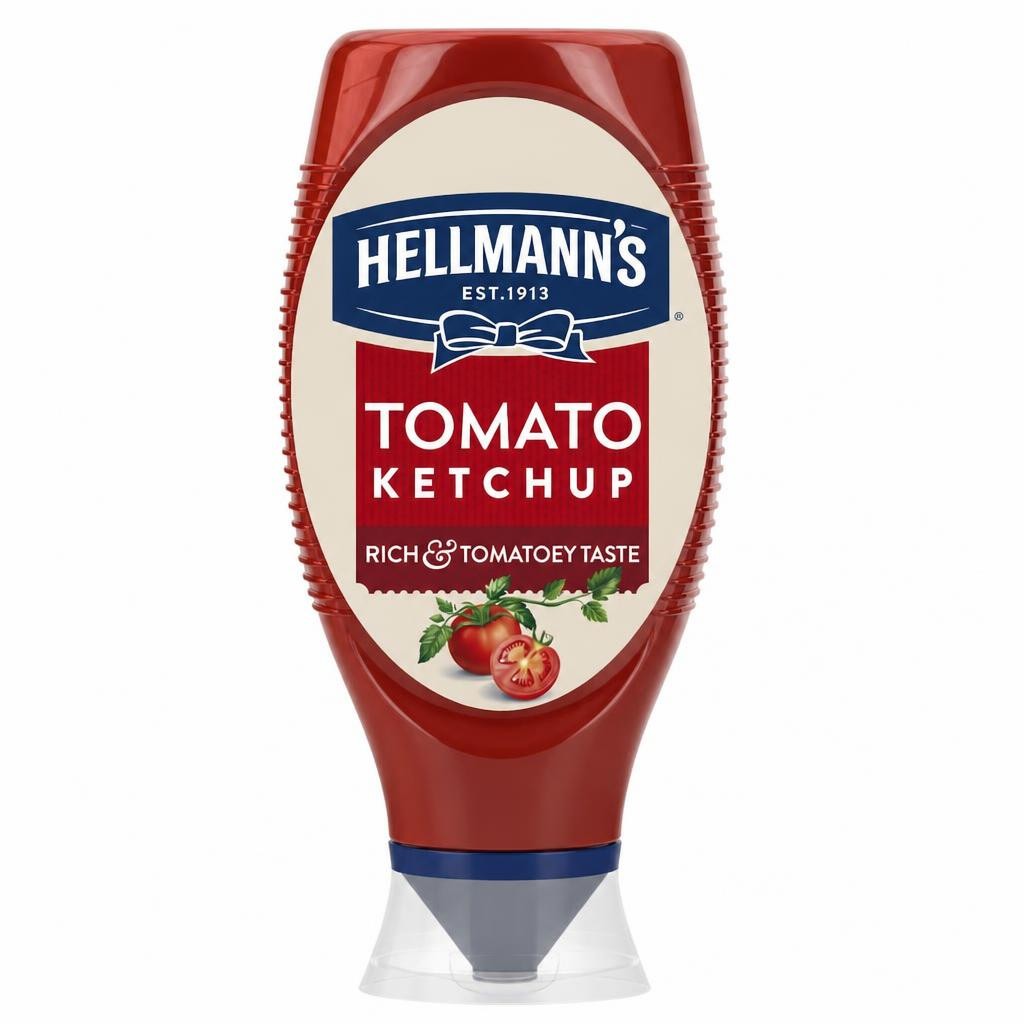
Hellmann's Tomato Ketchup 750ml
Ingredients: Water, tomato paste (30%), sugar, spirit vinegar, salt, natural flavourings
Hellmann's Tomato Ketchup 750ml er Ultra-processed.
Hellmann's Tomato Ketchup, on the other hand, has water as the main ingredient and only 30% tomato purée.
Why doesn’t it taste watery, then? Because the flavourings are used to make it still taste like ketchup. Flavourings can be produced in many different ways, but when labeled as natural, it should have a natural origin. However, it has undergone extensive industrial processing, and very little of the original whole material remains, making it a clear identifier of an ultra-processed food product.
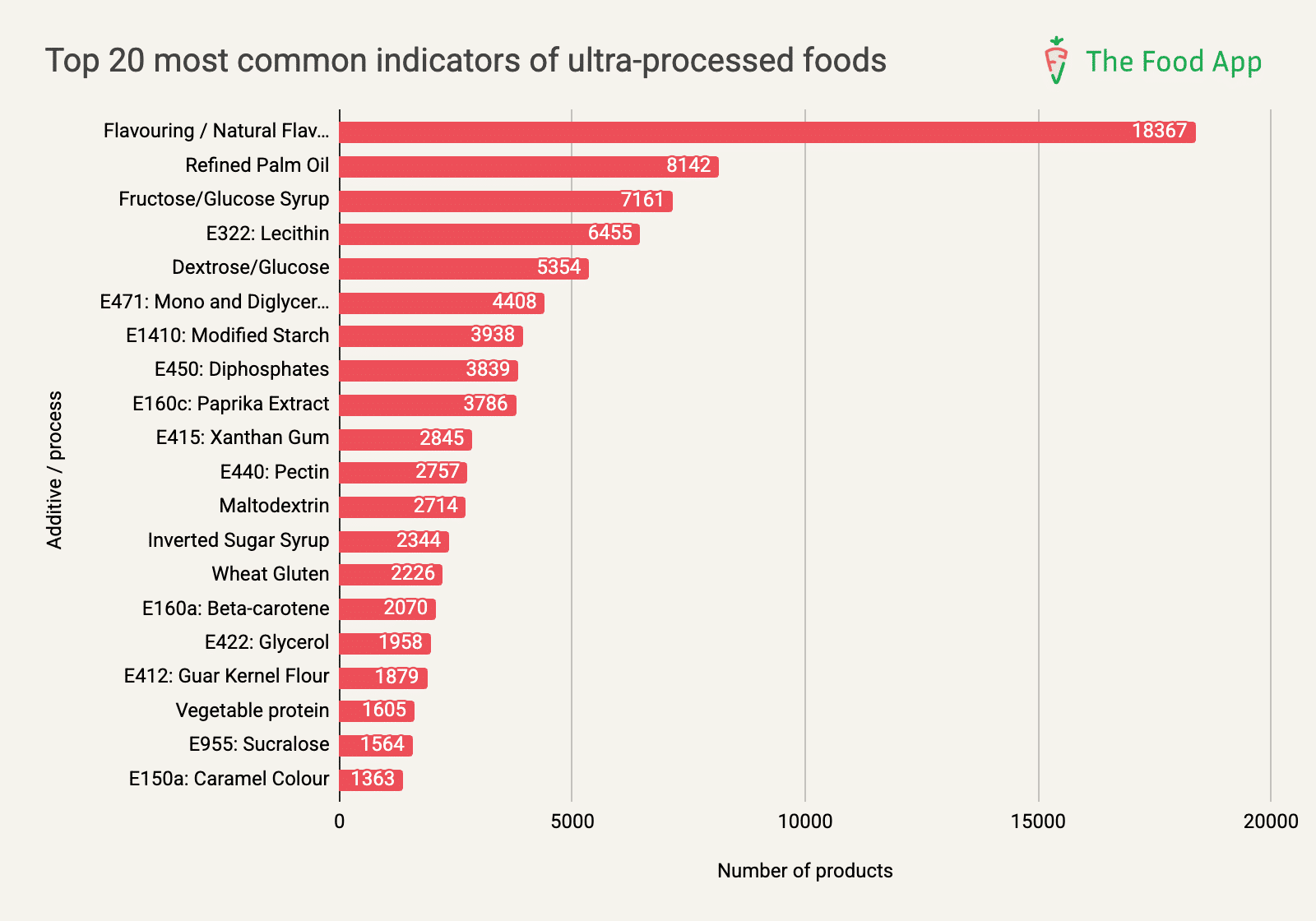
FLAVOURINGS: The most common indicator of ultra-processed food is flavourings, which are found in 70% of all ultra-processed foods.
Other common indicators of UPFs
In second place among the most common indicators of ultra-processed food, we find refined palm oil. Vegetable oils do not in themselves cause a product to be classified as ultra-processed. However, unlike oils such as rapeseed and sunflower, which are often cold-pressed, industrial palm oil is in most cases heavily chemically refined. It is also a cheap filler ingredient. Therefore, we regard palm oil as a clear indication of an ultra-processed product.
One category of widely used additives is emulsifiers, with the most common being lecithin (E322), mono- and diglycerides of fatty acids (E471), and diphosphates (E450). Emulsifiers make it possible to mix fat and water, which would otherwise separate.
Other thickeners such as guar gum (E412), modified starch (E1410), and xanthan gum (E415) are also widely used in ultra-processed foods.
There is also a wide use of sugar alternatives such as fructose/glucose syrup, dextrose/glucose and maltodextrin. These are various forms of simple sugars that are heavily industrially processed in order to give products specific properties and textures.
20% have only one indicator
Critics of the NOVA classification point out that only a single indicator is required for a food product to be classified as ultra-processed. NOVA also considers only these indicators of processing in the ingredient list and does not directly assess nutritional content.
As a result, many food products fall under the category of ultra-processed foods simply because, for example, a colouring has been added.
At the same time, it can be argued that such additives are entirely unnecessary, as they contribute nothing beyond enhancing the product’s appearance. So-called «cosmetic additives».
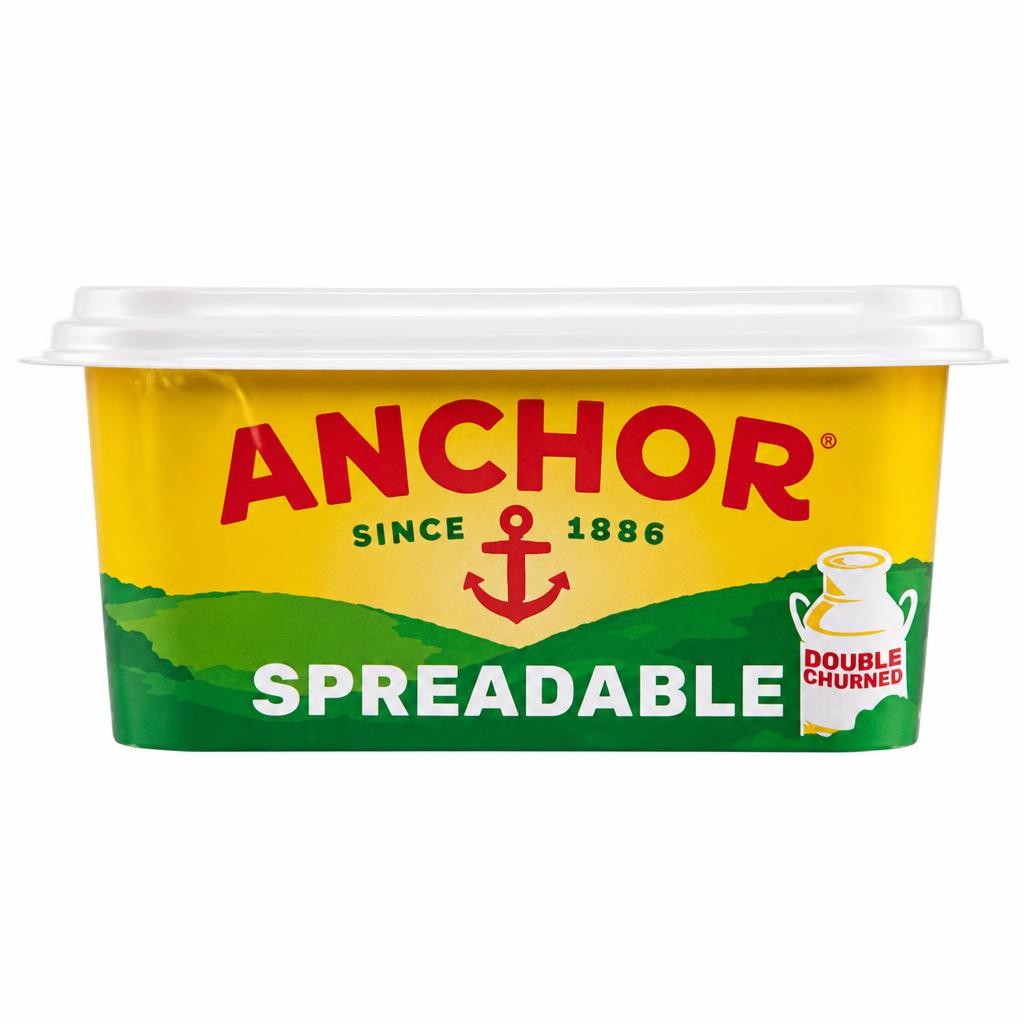
Anchor Spreadable Blend of Butter and Rapeseed Oil
Ingredients: Anchor Butter (50%) (Milk), Rapeseed Oil (29%), Water, Salt (1.1%), Colour (Beta Carotene)
Anchor Spreadable Blend of Butter and Rapeseed Oil er Ultra-processed.
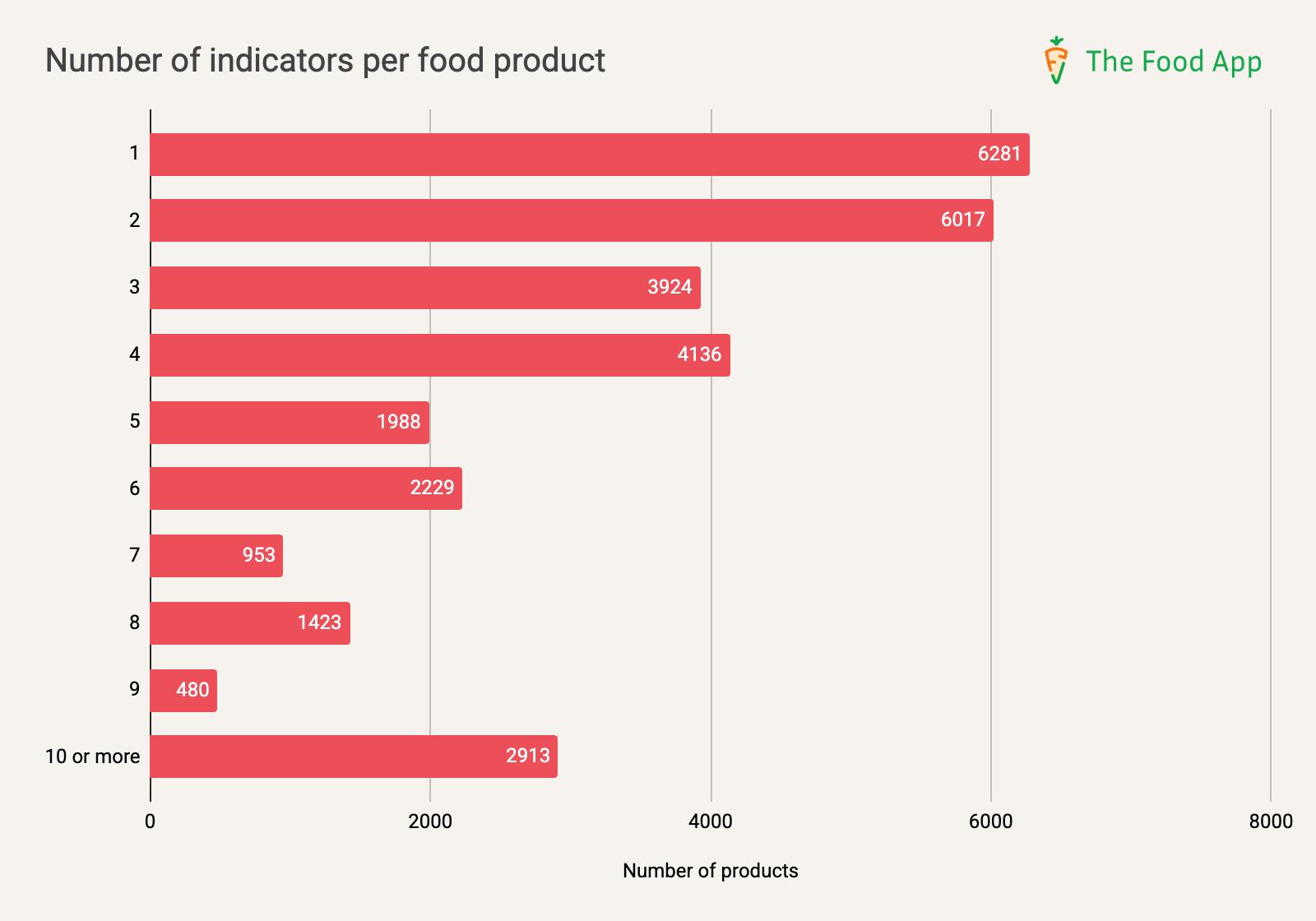
ONE INDICATOR IS ENOUGH: 20% of the foods we identified as ultra-processed had only one indicator.
Distribution by category
Unsurprisingly, ultra-processed foods are most prevalent in categories such as desserts and ice cream (86%), bakery (86%), and snacks and sweets (81%). These categories contain many industrial products with long ingredient lists and numerous additives.
However, categories such as spreads and breakfast products (68%), and chicken and poultry (67%), also have an above-average proportion of ultra-processed products.
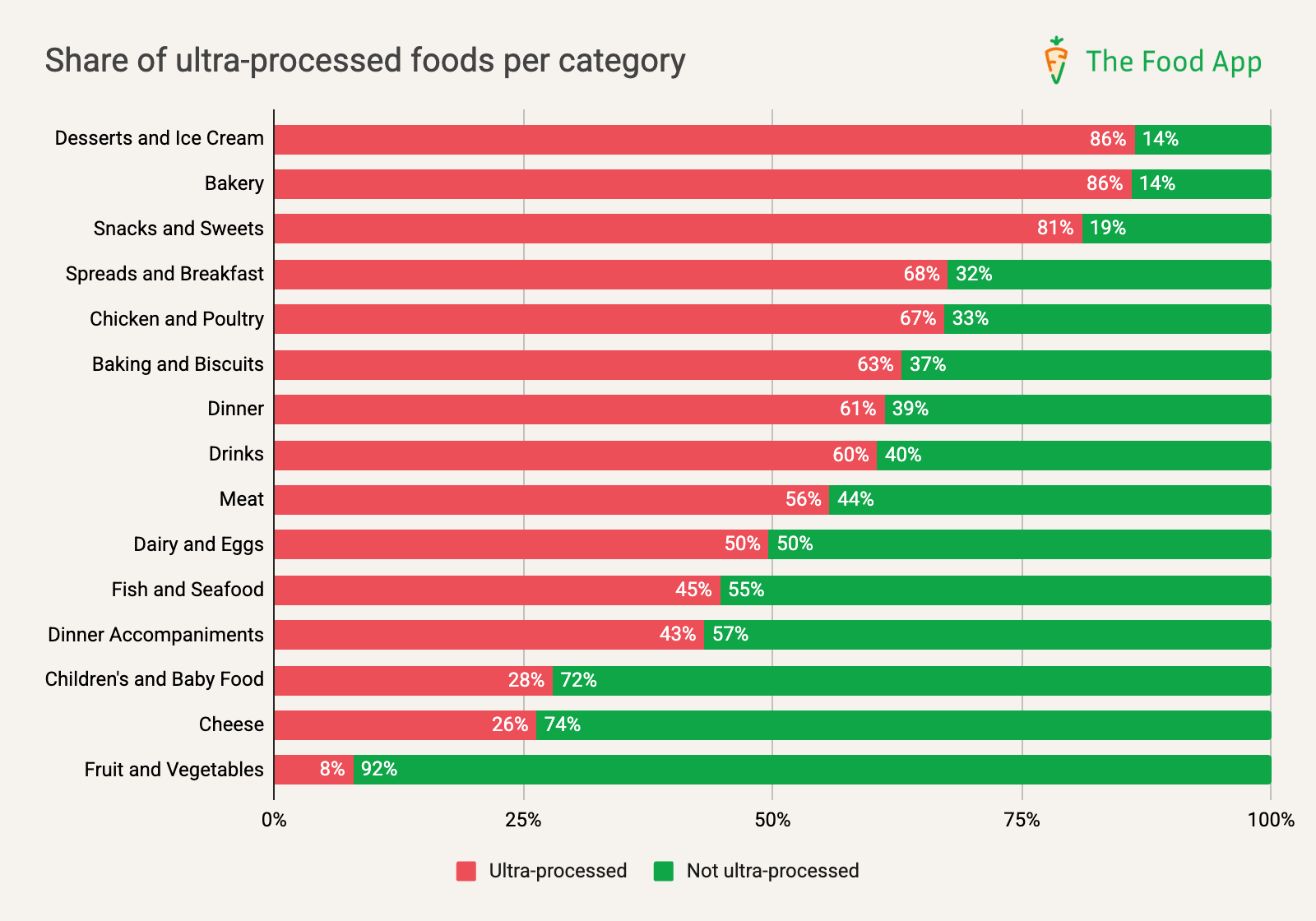
DESSERTS AND ICE CREAM AT THE TOP: Perhaps unsurprisingly, the highest proportion of ultra-processed products is found in the desserts and ice cream category.
Details on data extraction, methodology and sources
Product data were extracted from The Food App’s database on 29 April 2026, comprising a total of 50,137 food products. These are products found in the largest supermarkets in the United Kingdom, including Tesco, Sainsbury’s and ASDA. We also extract product data from images submitted by users of The Food App. AI is used to read the data, with human quality control.
Analysis of ingredient lists to classify ultra-processed foods is carried out using proprietary algorithms, partly AI-assisted, based on the NOVA classification. Scientific source: Ultra-processed foods: what they are and how to identify them.
You are welcome to use our data and refer to this report, provided that we are credited and linked to. We can also supply more detailed data and statistics on request. Read more on our press and partnerships page.